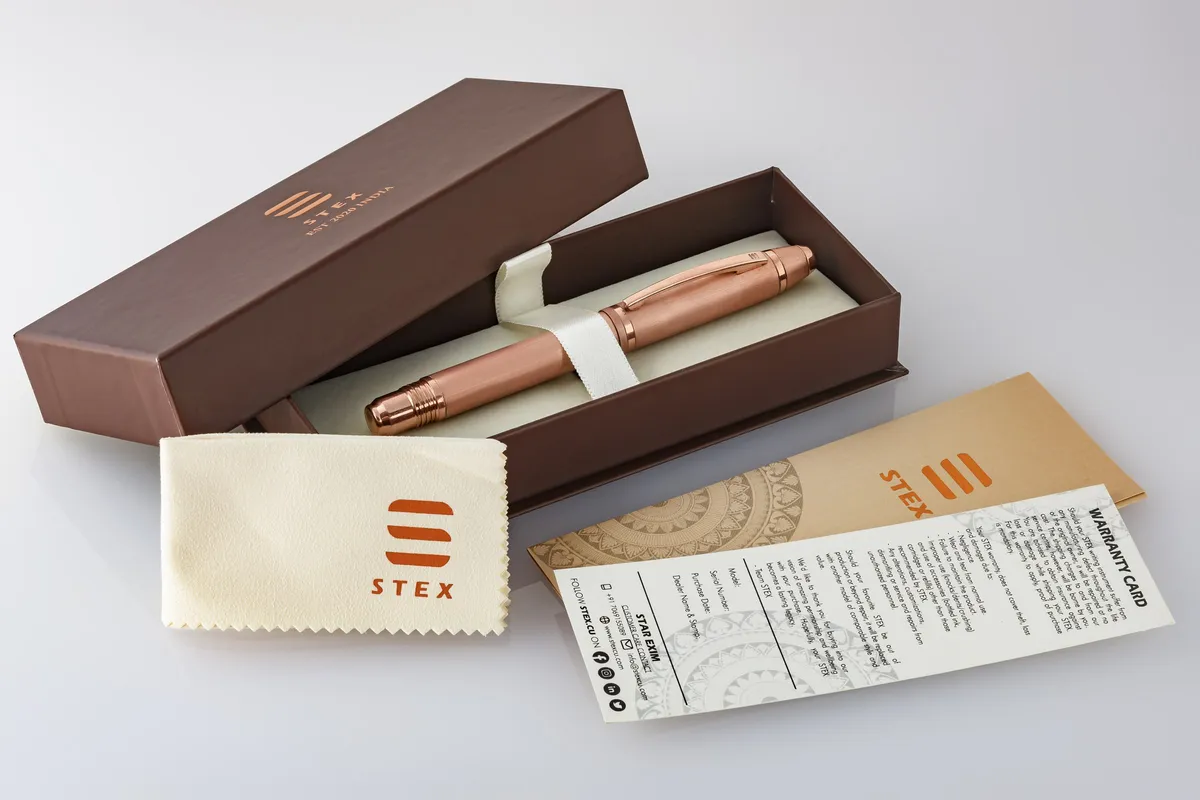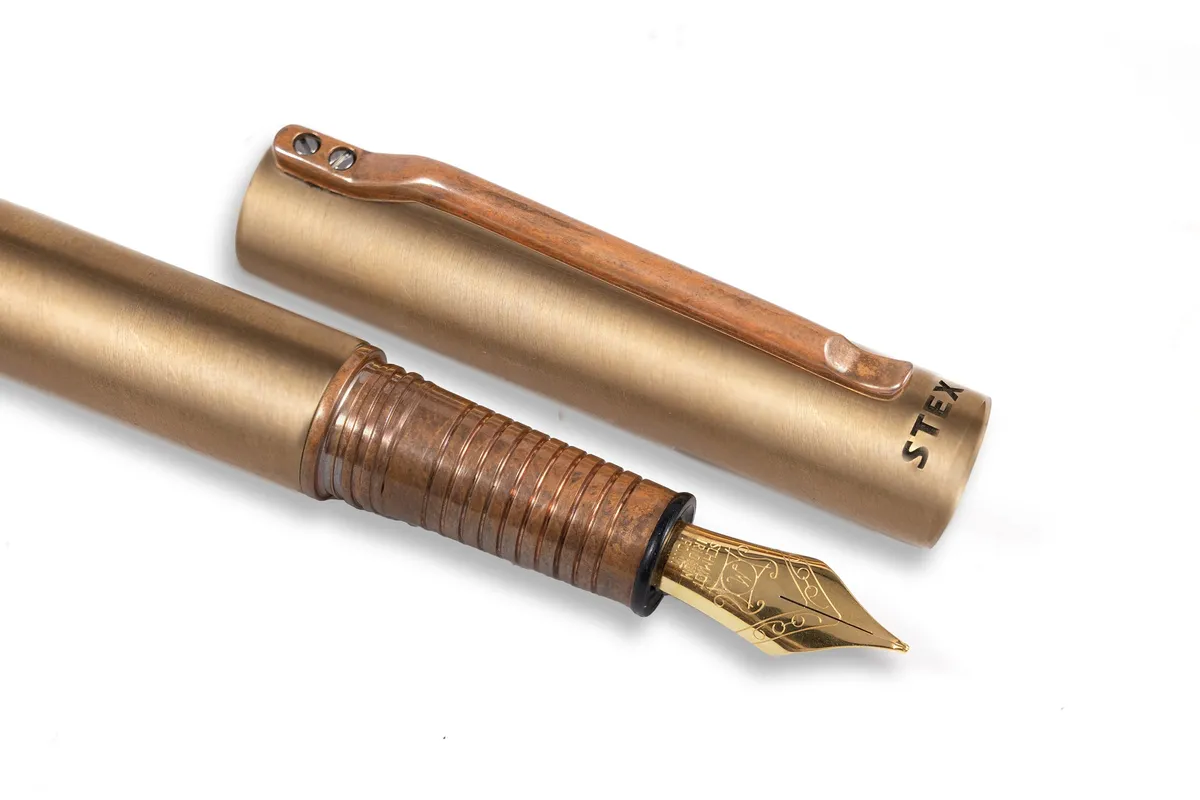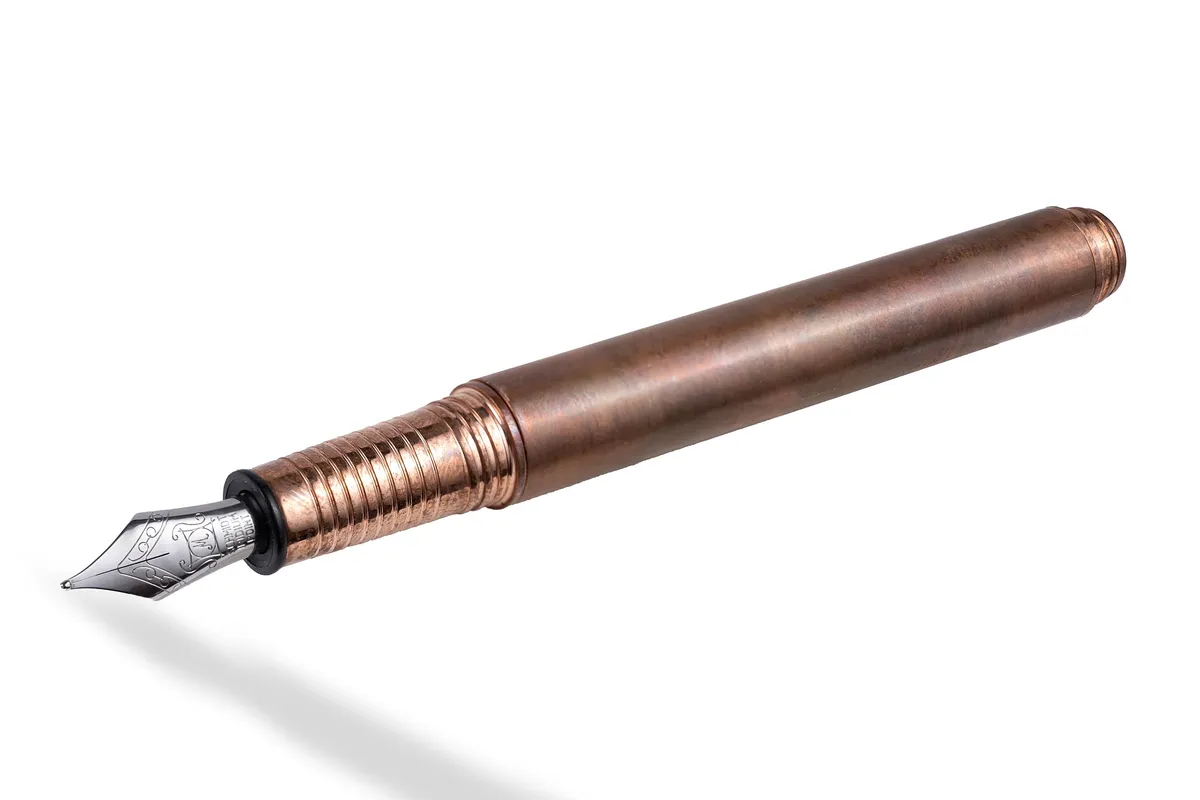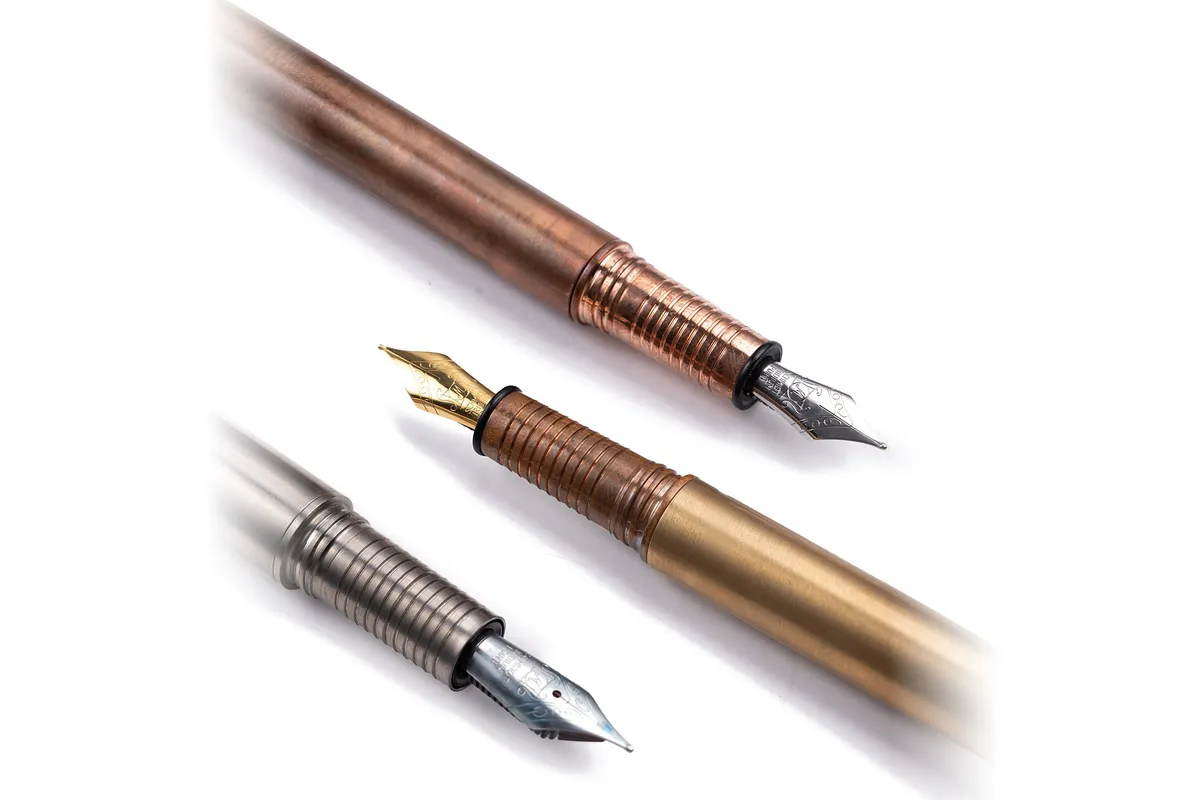
Every STEX pen starts as a solid bar of metal that is machined, threaded and finished by hand in our workshop in India. The metal you choose decides almost everything about how the pen feels: its weight, its temperature in the hand, how it looks after a year and how much care it wants. Here is how the three main metals compare.
The short version
| Copper | Brass | Titanium | |
|---|---|---|---|
| Feel | Warm, dense, substantial | Dense, slightly harder | Light, cool, technical |
| Weight (same shape) | Heaviest | Nearly as heavy as copper | About half the weight |
| Colour | Rose that darkens to brown | Gold that mellows to brown-gold | Grey that never changes |
| Patina | Fast and deep | Slower and softer | None |
| Care | Wipe; polish if you want shine | Wipe; polish occasionally | Wipe |
Copper
Copper is the reason STEX exists. Our founders spent more than twenty years in the copper trade before they made a pen, and pure copper is still the heart of the range.
Why people choose it: copper is dense (around 8.9 grams per cubic centimetre), so a copper pen has a reassuring weight that steadies your writing. It warms quickly to your hand. And it changes: from bright rose to satin to deep chocolate, darker where you hold it. If you want a pen that becomes recognisably yours, choose copper. Our guide to copper patina explains what happens to the surface.
Things to know: copper is softer than brass or titanium, so it will pick up small marks if it shares a pocket with keys. Most owners see those marks as part of the story. If you prefer the shine, cleaning copper takes a minute with lemon and salt.
Try it in: the 137C in copper, a 137 mm pen that posts to 172 mm, or the shorter 100C in copper.
Brass
Brass is an alloy of copper and zinc. It keeps much of copper's weight but is harder and more golden.
Why people choose it: brass looks like warm gold when new and ages more slowly than copper, to a mellow honey-brown. It resists small dents better and keeps crisp edges on clips and threads. STEX pairs brass with copper on the CuBr models, so you get two tones that age at different speeds.
Things to know: brass still develops a patina, just a gentler one. Polish it the same way as copper if you want the first-day colour back.
Try it in: the 137C CuBr or the 100C CuBr.
Titanium
Titanium is the metal of aircraft frames and surgical implants: strong, light and almost inert.
Why people choose it: titanium is roughly 40 to 45 percent lighter than steel and about half the density of copper, so a titanium pen is the one you forget you are holding during a long writing session. It forms its own invisible oxide layer, so it never tarnishes, never turns green and needs nothing but a wipe. It is also the natural choice for anyone with a sensitivity to copper.
Things to know: titanium feels cooler in the hand and has a more technical, matte grey look. It is harder to machine than copper, which is part of why titanium pens cost more.
Try it in: the 137C in titanium or the 100C in titanium. The CuTi models combine a titanium body with copper details, so you get the lightness of one and the warmth of the other.
How weight changes the way you write
Weight is not just a number. A heavier pen like a copper 137C (62 g) does more of the work for you: let it rest in the hand and it glides with very little pressure, which many people find calmer and neater for slow, deliberate writing. A lighter pen, such as the slim Magnum R roller at 24.1 g, is quicker to move and less tiring over pages of notes. Read more in pen weight and balance, or use the weight finder on our home page to see where every STEX pen sits between about 24 g and 58 g.
Which metal should you choose?
- You journal, write letters or sign documents slowly: copper.
- You like gold tones and want a slower-changing patina: brass or a copper-brass combination.
- You write long notes, travel often or want zero maintenance: titanium.
- You can't decide: a CuTi pen gives you titanium's lightness with a copper accent that still ages.
Whichever you pick, every STEX pen ships free with tracking, and prices show in rupees in India and US dollars everywhere else. Browse them all in the fountain pen collection.
Questions people ask
Is a copper pen heavier than a titanium pen?
Yes. Copper is roughly twice as dense as titanium, so the same pen shape weighs close to twice as much in copper. That extra weight is why copper pens feel so steady on the page.
Does a brass pen tarnish?
Yes, but more slowly and more softly than copper. Brass mellows from bright gold to a honey-brown over months and can be polished back to gold whenever you like.
Which pen metal is best for sensitive skin?
Titanium. It is inert, does not tarnish and is widely used for medical implants and jewellery for people with metal sensitivities.