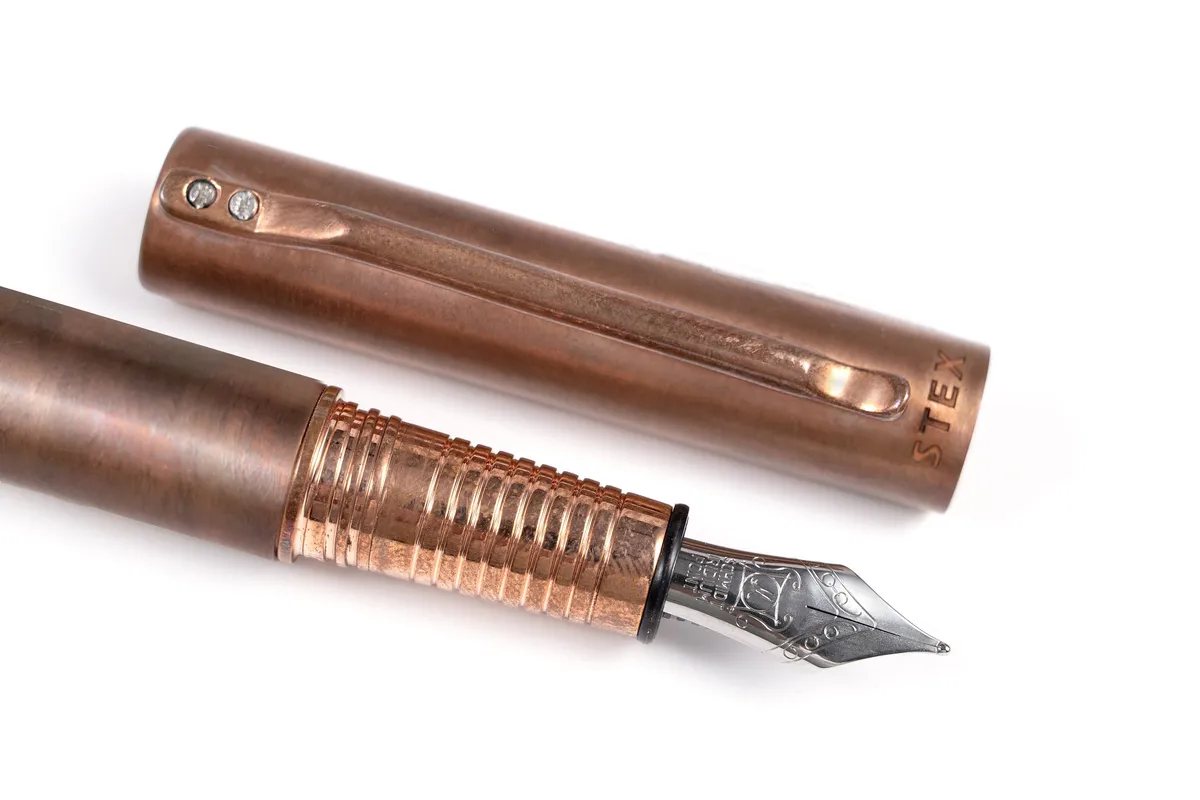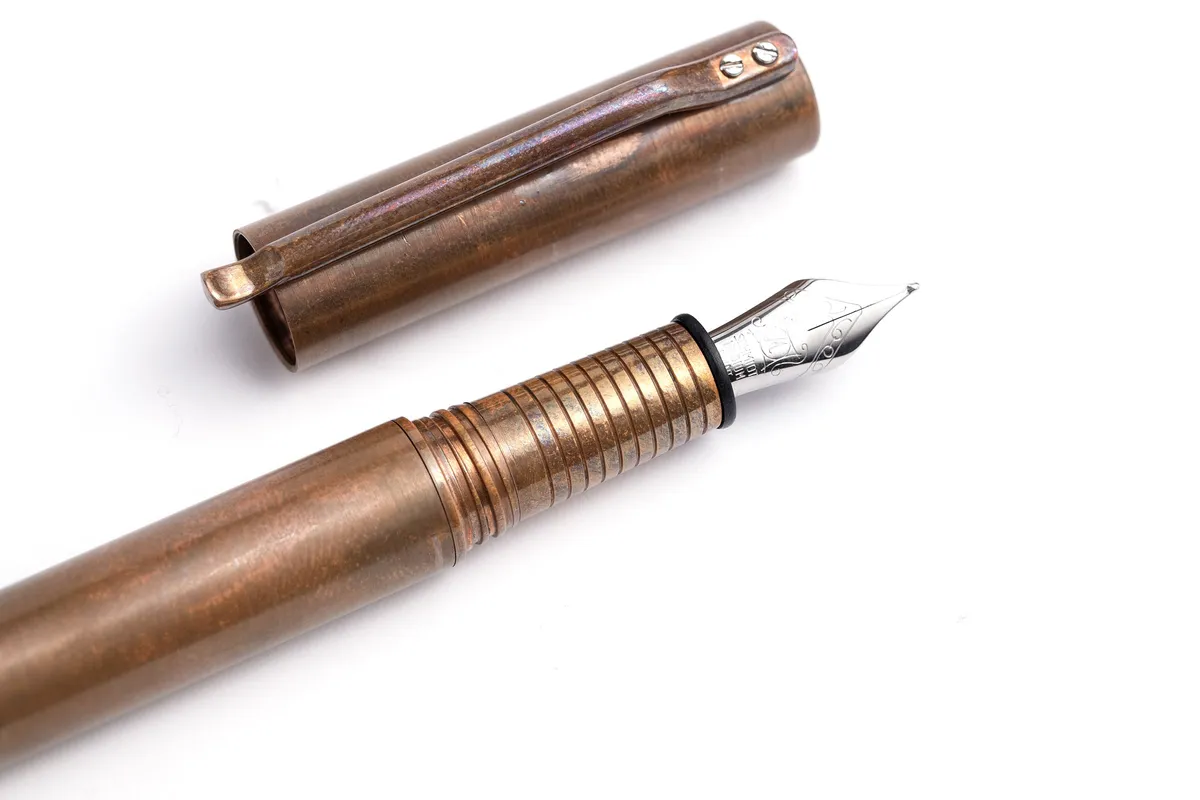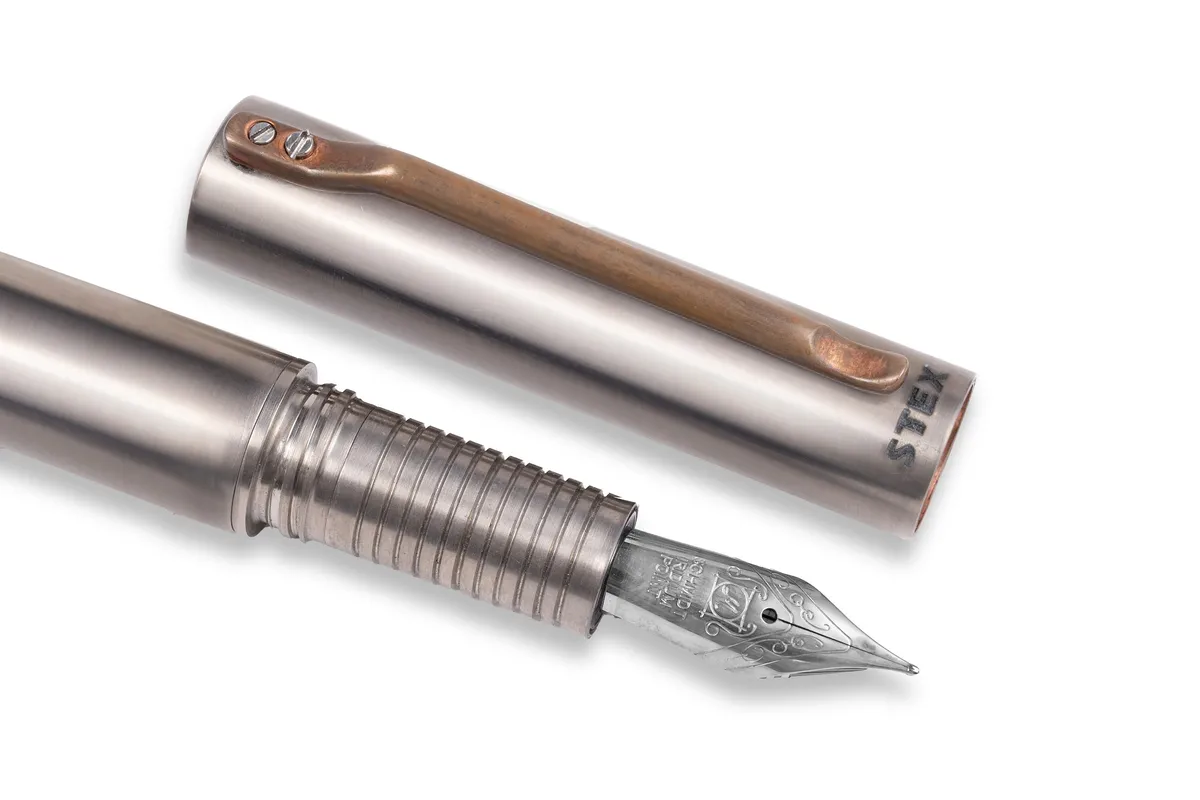
The body of a STEX pen is copper, brass or titanium, machined and finished by hand in India. The part that touches the paper comes from Germany. Every STEX fountain pen is fitted with a Schmidt nib, and every STEX roller pen takes a Schmidt refill. Here is why, and what that means for your writing.
Who makes Schmidt nibs?
Schmidt is a German company in the Black Forest that has specialised in the working parts of pens for decades: nibs, converters and refills. Many pen makers around the world, especially independent and small-batch makers, fit Schmidt units rather than making their own, because a good nib is a precision part. Its tip has to be ground, polished and slit so that ink flows evenly at every angle you might hold the pen.
What a nib is made of
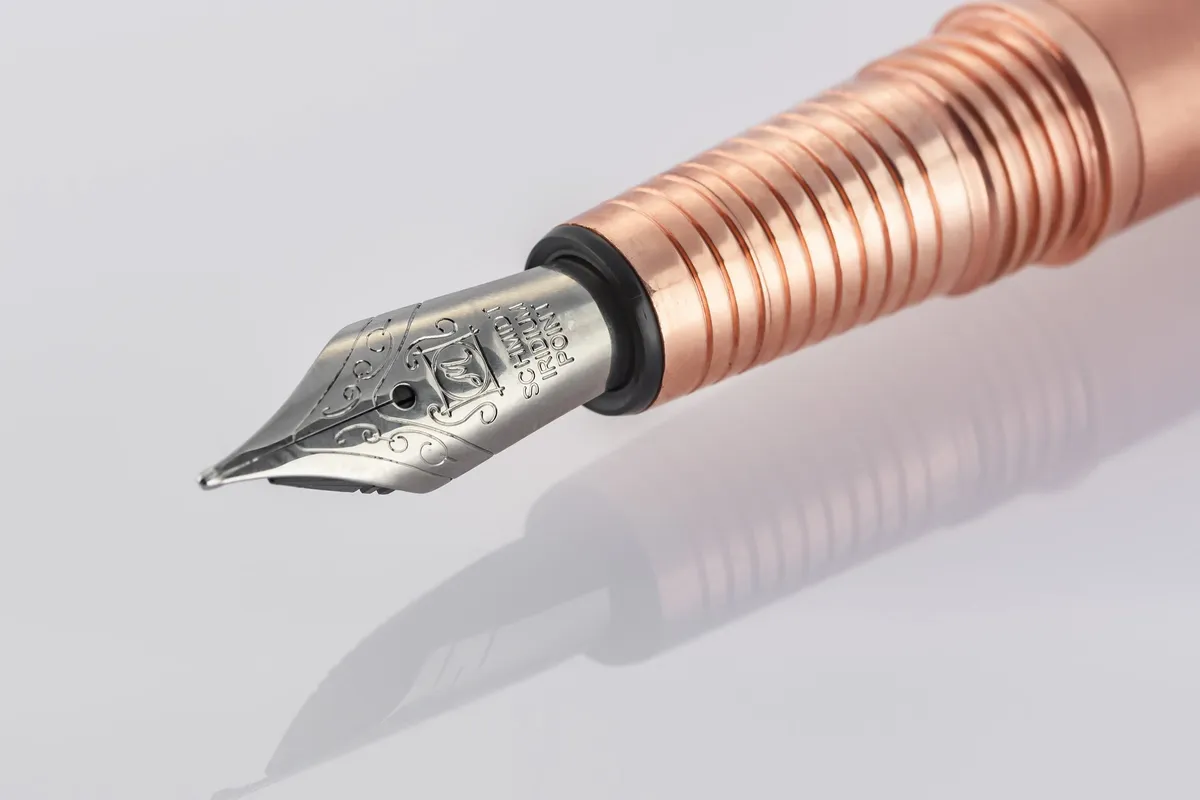
A Schmidt steel nib has three parts you can see:
- The nib itself, a curved, stamped and polished sheet of stainless steel, often with decorative engraving.
- The tipping, a tiny bead of hard alloy welded to the point and ground smooth. This is what actually touches the paper, and it is why a steel nib can write for many years without wearing.
- The slit and breather hole, which split the nib in two and let air in as ink flows out, so ink moves by capillary action from the feed to the paper.
Under the nib sits the feed, a ribbed plastic piece that meters ink from the converter or cartridge. Nib and feed are designed together, which is one reason a well-matched unit like Schmidt's writes reliably from the first stroke.
Nib widths, in plain words
Nib widths are labelled by letters. As a rough guide for a European steel nib:
| Width | Label | Line | Good for |
|---|---|---|---|
| Extra fine | EF | Very thin | Small handwriting, diaries, thin paper |
| Fine | F | Thin | Everyday notes, forms, small writing |
| Medium | M | Moderate | Letters, journals, signatures |
| Broad | B | Wide | Large handwriting, showing off ink colour |
A broader nib lays down more ink. That makes colours and shading in the ink more visible but needs better paper and a little more drying time. A finer nib is more forgiving on office paper and better for small writing.
Many STEX pens ship with a Schmidt medium nib; each product page lists the nib in its specifications, such as the D'magno or the Magneto. If you need a different width, write to us before you order and we'll tell you what's possible.
How to choose your nib width
Ask two questions.
How big is your handwriting? If your lowercase letters are smaller than about 2 mm, choose fine. If they are larger, medium will look better and feel smoother.
What paper do you use? Thin, absorbent office paper makes broad lines feather and bleed. On good notebook paper of 80 gsm or more, medium and broad nibs show off ink beautifully.
If in doubt, choose medium. It is the most popular width for good reason: smooth enough to glide, fine enough for everyday notes.
Caring for a steel nib
Steel nibs are tough, but they reward a little care:
- Write with light pressure. A fountain pen needs only the weight of your hand; pressing hard can spread the tines.
- Keep the pen capped when you aren't writing, so ink doesn't dry in the feed.
- Flush it with water every few weeks, or whenever you change ink. Our guide to caring for a fountain pen explains how.
- Use fountain pen ink only. Drawing ink and India ink contain binders that clog the feed. See choosing ink for a metal pen.
Converters and refills
Schmidt also makes the converter in STEX fountain pens: a small piston reservoir that lets you fill from any bottle of fountain pen ink. When you travel, the same pens accept standard international cartridges. And STEX roller pens use standard Schmidt refills, sold by good stationers worldwide, so a STEX pen stays in use for decades. Our step-by-step filling guide shows both methods.
Questions people ask
Are Schmidt nibs good?
Yes. Schmidt nibs are widely used by independent pen makers because they write smoothly and consistently and are easy to service. They are stainless steel with a hard-alloy tip that lasts for years of daily writing.
Which nib size should a beginner choose?
Medium (M) suits most beginners and most handwriting. Choose fine (F) if your handwriting is small or you mostly write on thin office paper.
Can I change the nib on a STEX pen?
Write to STEX before ordering if you need a nib width other than the one listed; the team will tell you what is available for that model.